
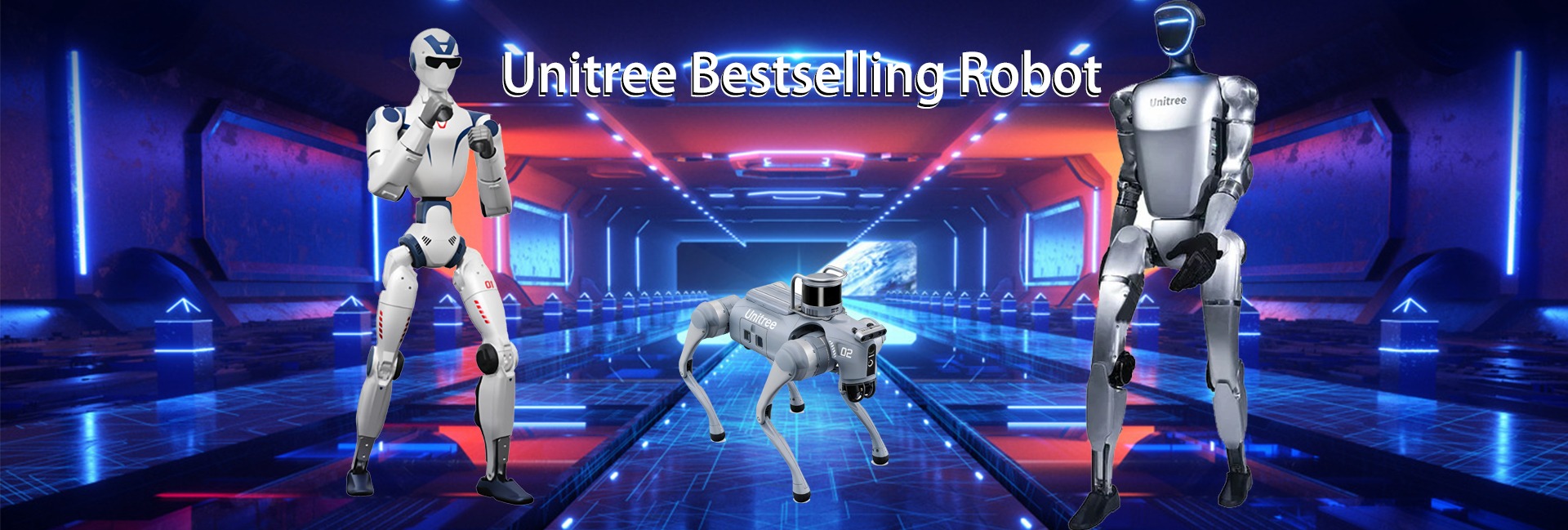

ENGINEAI PM01 & T800 Humanoid Robots
ENGINEAI PM01: Lightweight, High-Dynamic General Embodied Agent
The PM01 is a compact humanoid platform (~1.38 m tall, ~40 kg) designed for high-dynamic motion and full-stack development. It features 24 degrees of freedom (DoF) with a wide-range waist rotation, enabling agile movements such as front flips, dancing, and dynamic running (up to ~2 m/s). Powered by high-torque joint modules, it supports dual locomotion modes (mechanical and natural human-like gait). The platform is built for openness, integrating Intel + NVIDIA Jetson Orin computing and extensive SDK/ROS support for embodied AI research, making it suitable for education, commercial demonstration, and algorithm development.
ENGINEAI T800: Full-Size High-Performance Universal Humanoid
The T800 is a full-size industrial-grade humanoid (~1.73 m tall, ~75-85 kg) built for heavy-duty tasks and extreme dynamic performance. It boasts up to 43 DoF (including 7-DoF dexterous hands with tactile sensing) and is driven by high-power joint actuators capable of 450 N·m peak torque, supporting powerful motions like high-speed running (3 m/s), kicking, and backflips. Equipped with 360° LiDAR and stereo vision, it offers robust perception for autonomous navigation. The T800 targets demanding applications in manufacturing logistics, heavy payload handling (5+ kg), and advanced R&D, featuring long-endurance battery options for extended operational cycles.
Unitree R1 Humanoid Robot (Brief Introduction)
The Unitree R1 is a lightweight, affordable humanoid platform designed to make advanced robotics accessible to developers, educators, and enthusiasts. Standing at approximately 1.23 meters tall and weighing around 29 kg, it combines dynamic motion capabilities with multimodal AI interaction at a disruptive price point starting under $5,000.
Key Features & Capabilities:
-
Dynamic Agility: Engineered with the philosophy "Movement first, tasks as well," the R1 features 20–26 degrees of freedom (depending on variant) and high-torque joints, enabling complex maneuvers such as backflips, somersaults, running, and self-righting from falls.
-
AI-Native Interaction: Integrates a Large Multimodal Model (LMM) for voice and vision, supported by a 4-mic array, dual speakers, and binocular or monocular cameras for natural human-robot interaction.
-
Developer-First Platform: The R1 EDU variant offers fully open joint and sensor control interfaces, optional NVIDIA Jetson Orin high-performance computing modules (40–100 TOPS), and SDK/ROS support for algorithm development and embodied AI research.
Target Applications:
Primarily aimed at R&D labs, university education, and commercial prototyping, the R1 serves as a versatile testbed for locomotion algorithms, manipulation tasks, and human-robot interaction studies, while also supporting entertainment and demonstration use cases.
Unitree G1 Humanoid Robot (Brief Introduction)
The Unitree G1 is a compact, mass-produced humanoid robot positioned as an affordable "AI Avatar" platform. Standing approximately 1.32 meters tall and weighing around 35 kg, it bridges the gap between advanced research and practical deployment .
Key Features & Capabilities:
-
Modular Agility: Configurable from 23 to 43 degrees of freedom (DoF), supporting optional 3-finger dexterous hands (Dex3-1) for manipulation tasks. It features a large joint motion range and a maximum knee torque of 120 N·m, enabling dynamic movements like standing up from the ground and trotting at speeds over 2 m/s.
-
AI-Native Sensing: Equipped with a depth camera and 360° 3D LiDAR (Livox Mid-360) for environmental perception, complemented by a built-in 4-mic array and speaker for multimodal interaction.
-
Developer-Friendly: The G1 EDU variant offers full SDK access, ROS 2 support, and optional NVIDIA Jetson Orin compute modules for high-level autonomy development. It utilizes a 9,000 mAh hot-swappable battery providing roughly 2 hours of typical operation.
The G1 is designed for continuous evolution via OTA updates integrated with Unitree's UnifoLM (Unified Large Model), targeting applications in education, research, entertainment, and early-stage industrial prototyping.
Unitree Go2 Series Overview
The Unitree Go2 series represents a versatile platform of mid-sized quadruped robots, balancing high-performance dynamics with advanced AI interaction. Built on a shared 12-degree-of-freedom (12-DoF) architecture, the series spans from accessible consumer companions to robust research and industrial tools.
1. Consumer Grade: Go2 Air & Go2 Pro
Designed for home interaction and entertainment, these models focus on user-friendly features and robust mobility.
Go2 Air: The entry-level model offers core quadruped mobility with a top speed of ~2.5 m/s, basic obstacle avoidance, and an affordable price point for tech enthusiasts.
Go2 Pro: The flagship consumer variant enhances the experience with 4D LiDAR (L2) for superior 360° perception, ISS 2.0 (Intelligent Side-follow System) for autonomous tracking, voice interaction, and a faster gait (up to 3.5 m/s). It serves as a capable platform for photography, pet-like companionship, and light payload tasks.
Shared Traits: Both feature ~15 kg weight, ~8 kg payload capacity, and support OTA updates for continuous feature improvement.
2. Research & Industrial Grade: Go2 EDU
This version unlocks the full potential of the Go2 platform for academia, R&D, and commercial applications.
Open Platform: Features an open SDK, ROS support, and full-body force control for algorithm development and complex locomotion research.
High-Performance Computing: Often configured with optional NVIDIA Jetson Orin modules (40-100 TOPS) for on-board AI processing, SLAM, and autonomous navigation.
Enhanced Endurance: Typically equipped with a 15000 mAh battery for extended experimental runtime (2-4 hours) and supports automatic docking.
Ideal Use Cases: University labs, industrial inspection prototypes, and advanced robotics programming.
3. Wheel-Leg Hybrid: Go2-W
A specialized variant that combines legged agility with wheeled efficiency for industrial mobility.
Hybrid Locomotion: Utilizes 7-inch pneumatic tires coupled with 16 active joints (4 legs), enabling seamless transitions between rolling on flat surfaces and climbing over obstacles.
Industrial Ruggedness: Boasts a higher obstacle surmountability (~70 cm) and a lower acoustic footprint, making it suitable for long-duration indoor/outdoor patrols and logistics.
Payload & Sensing: Supports modular payloads (e.g., thermal cameras, robotic arms) and is often paired with RealSense depth cameras and 3D LiDAR for industrial-grade autonomy.